
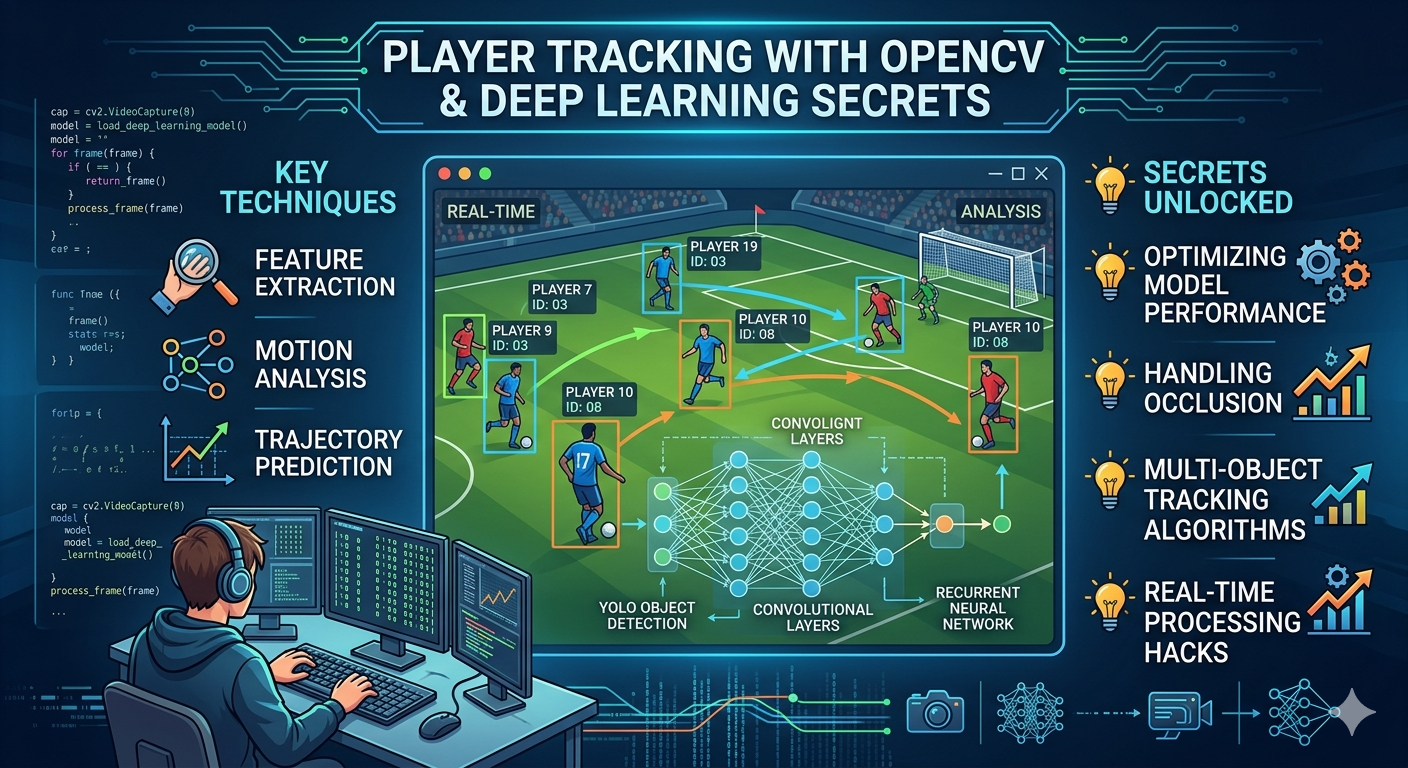
Earlier, analyzing player performance was very difficult. People had to watch match videos for so many hours and write down every movement typically. It also depended a lot on human judgment, which was not always exactlly. Now, things have changed a lot. With the help of computer vision and deep learning, machines can do most of this work. They will be tracking players, study their steps, and give results in real time.
nowadays AI systems are very advanced. They can track player positions with very high accuracy, almost to the level of centimeters. This is a big development compared to older GPS systems, which could only measure positions in meters.
- What is player tracking?
- How it works
- Which tools are used
- Real examples (sports, games, CCTV)
- How to learn this in a data science course
What is Player Tracking?
Player tracking is a simple idea. It means finding a player in a video and following their movement. For example, imagine you are watching a football match. There are many players on the ground. If you want to follow only one player, you need a system that can detect that player and track them from start to end. This is called player tracking.
In simple words, player tracking answers two questions:
- Where is the player?
- How is the player moving?
This information is very useful. It helps to understand performance, speed, position, and behavior. That is why many industries use this technology.
Understanding Video and Frames
Before learning player tracking, you should understand one basic thing. A video is not a single picture. It is a collection of many images. These images are called frames.
For example, if a video has 30 frames per second, it means 30 images are shown every second. When these images play very fast, we see it as a video.
In player tracking, the system looks at each frame one by one. It finds the player in every frame and then connects the movement. This is how tracking works.
Tools Used in Player Tracking
There are two main tools used in player tracking: OpenCV and Deep Learning. Let us understand them in a simple way.
OpenCV
OpenCV is a library used for image and video processing. It helps the computer to “see” images and videos. With OpenCV, we can:
- Read videos
- Break videos into frames
- Draw boxes around objects
- Track movement
OpenCV is easy to learn and very popular in computer vision projects.
Deep Learning
Deep Learning is a part of artificial intelligence. It helps the system to understand what it is seeing. For example, it can identify whether an object is a person, ball, or something else.
In player tracking, deep learning is used to detect players. It makes the system smart. Even if players move fast or overlap, deep learning models can still identify them.
Some popular models are:
- YOLO (You Only Look Once)
- CNN (Convolutional Neural Network)
YOLO is widely used because it is fast and works in real time.
How Player Tracking Works (Step by Step)
Now let us understand the full process in a simple way.
First, a video is given as input. This video can be a sports match or any recording. Then OpenCV reads the video and converts it into frames. Each frame is like a photo.
Next, a deep learning model looks at each frame and detects the players. It draws a box around each player. This is called object detection.
After detection, the system starts tracking. It follows the same player across different frames. Even if the player moves, the system keeps tracking them.
Finally, the output is shown. You can see the player’s movement, path, and position. Sometimes, the path is shown as a line or highlighted area.
Real-Life Examples of Player Tracking
Player tracking is used in many real-life situations. Let us look at some simple examples.
In football, player tracking helps coaches understand how players move on the field. They can see which areas a player covers and how fast they run. This helps in improving performance.
In cricket, tracking is used to analyze batting and bowling positions. It can show how a player stands and moves during the game.
In CCTV systems, tracking is used for security. It helps to follow a person in a video and understand their activity. This is useful in public places like malls and airports.
In gaming, motion tracking is used to detect player movements. It makes games more interactive and realistic.
These examples show that player tracking is not only for sports. It is used in many industries.
Why Player Tracking is Important
Player tracking is important because it gives useful data. This data helps in making better decisions.
For example, a coach can use tracking data to improve a player’s performance. They can understand strengths and weaknesses.
In security, tracking helps to monitor people and prevent problems. It makes systems safer.
In business, tracking can be used to understand customer movement. This helps companies improve their services.
Another important reason is career growth. Player tracking is part of computer vision, which is a high-demand skill. Many companies are looking for people who know these skills.
What You Will Learn in a Data Science Course
If you join a data science course, you will learn player tracking step by step. The course will start with basic concepts.
First, you will learn Python programming. Python is easy and widely used in data science.
Then you will learn OpenCV. You will understand how to work with images and videos.
After that, you will learn deep learning basics. You will study how models like YOLO work.
Finally, you will build projects. For example, you may create a system that tracks a player in a video. These projects help you gain practical knowledge.
The good thing is you do not need advanced knowledge to start. You can learn everything step by step.
Simple Beginner Project Idea
To understand player tracking better, you can try a simple project.
Take a sports video from the internet. Use OpenCV to read the video and display frames. Then use a pre-trained YOLO model to detect players. Draw boxes around them.
After that, try to track one player across frames. You can use simple tracking methods available in OpenCV.
This small project will help you understand the full concept. You will learn how detection and tracking work together.
Career Opportunities After Learning Player Tracking
Learning player tracking can open many job opportunities. It is part of computer vision and AI, which are growing fields.
You can work as a data analyst and handle video data. You can become an AI engineer and build smart systems. You can also become a computer vision engineer and work on advanced projects.
Many industries need these skills. Sports companies, security firms, and tech companies all use tracking systems.
In India, cities like Hyderabad, Bangalore, and Pune have many job opportunities in this field.
Skills You Need to Learn
To work on player tracking, you need some basic skills.
You should know Python because it is the main programming language. You should learn OpenCV for video processing. You should understand deep learning basics.
It is also good to learn libraries like TensorFlow or PyTorch. These tools help in building models.
Do not worry if you are a beginner. You can start with small steps and improve slowly.
⚖️ Simple Comparison: Without vs With Player Tracking
Without player tracking, people watch videos manually. It takes time and effort. It is also difficult to get accurate data.
With player tracking, the system does everything automatically. It gives fast and accurate results. It also saves time.
This is why companies prefer automated tracking systems.
🎯 Final Conclusion
Player tracking with OpenCV and Deep Learning is a powerful and useful concept. It is easy to understand if you learn step by step. It is used in sports, security, and many other fields.
The demand for this skill is growing in 2026. If you learn it now, you can build a strong career in data science and AI.
Start with basics, practice small projects, and improve your skills. With time and effort, you can become an expert.